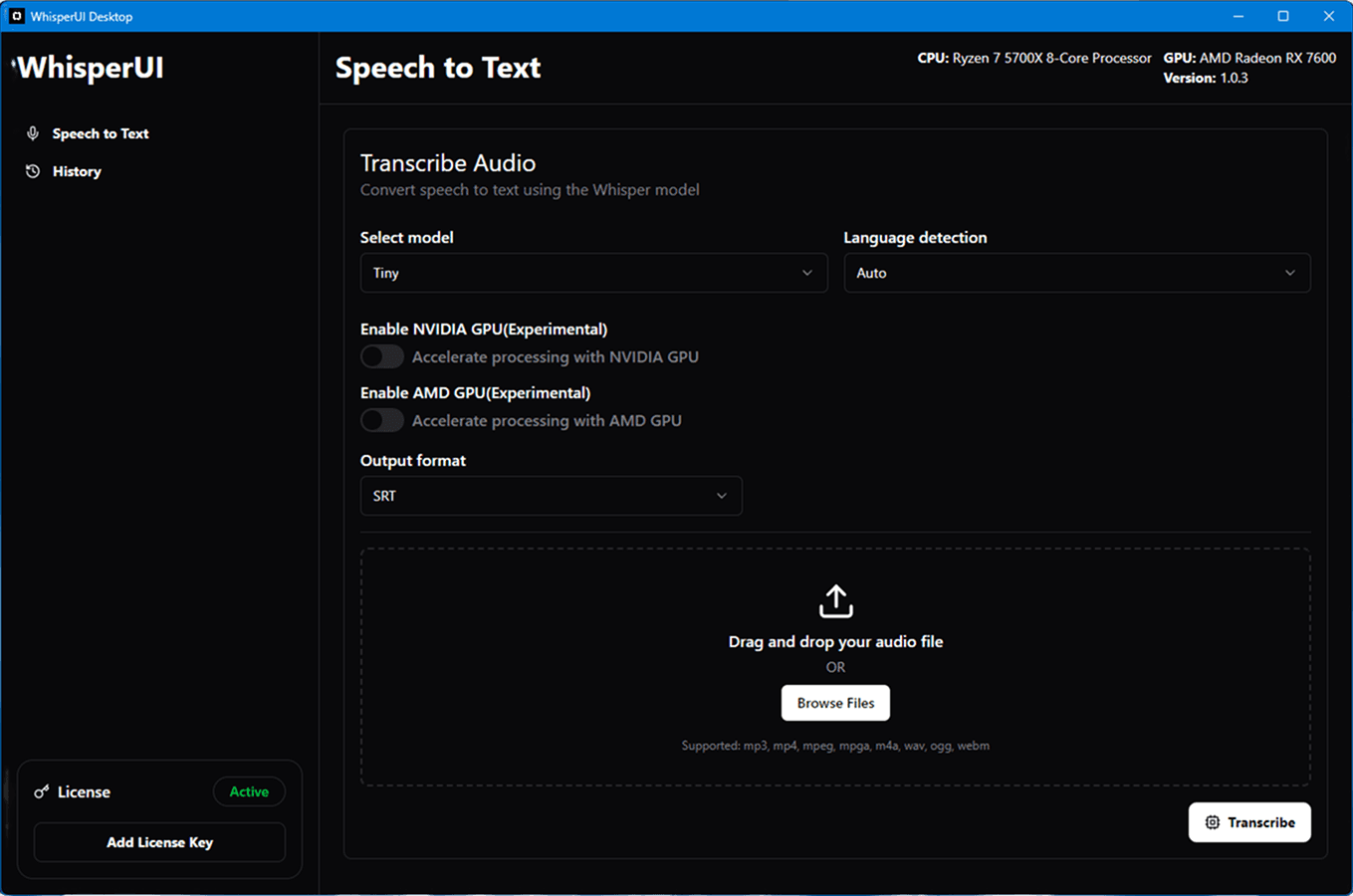
Whisper GUI with NVIDIA GPU Acceleration: Setup Guide
WhisperUI Desktop includes experimental NVIDIA GPU acceleration for compatible Windows computers. A GPU can provide another way to process local transcription workloads, but it is optional: the desktop app also supports CPU processing, which should be your starting point and fallback.
This guide explains how to prepare a Windows computer, verify the base Whisper GUI workflow, evaluate NVIDIA processing without relying on invented speed claims, and isolate common problems.
What NVIDIA acceleration changes
Local transcription consumes computing resources on your own machine. With CPU processing, the central processor performs the work. With compatible GPU acceleration, part of that workload can use the NVIDIA graphics processor instead.
Whether that improves a specific job depends on several variables:
- The exact NVIDIA GPU and its available memory.
- The Windows and graphics driver environment.
- Recording duration and workload.
- Other applications using the GPU at the same time.
- Available system memory and storage performance.
Because those variables differ, WhisperUI does not promise one universal performance multiplier. Test your own recurring workload and compare it with the CPU baseline on the same computer.
GPU acceleration is optional
You do not need an NVIDIA card to use the Whisper GUI for Windows. WhisperUI Desktop supports local CPU processing on Windows 10 and 11.
Treat the two modes this way:
| Processing mode | Role in the workflow |
|---|---|
| CPU | Compatibility baseline and dependable fallback |
| NVIDIA GPU | Experimental acceleration option for compatible Windows hardware |
| Cloud | Optional processing that does not use the local CPU or GPU for the transcription job |
This separation matters during troubleshooting. If CPU processing succeeds but GPU processing fails, the installer, license, file access, and general desktop workflow are already working. You can then focus specifically on acceleration compatibility.
Before enabling NVIDIA processing
Confirm the supported Windows setup
WhisperUI Desktop supports Windows 10 and Windows 11 on x64 computers with at least 4 GB of RAM. Heavier workloads can benefit from more available memory, but no single memory amount guarantees a particular processing time.
Start with the current desktop release
Download the Windows x64 installer from the WhisperUI Desktop releases page. The releases page is maintained as the source for current installers, so avoid old version-specific download links.
Activate the desktop license
Start the three-day trial or an active plan and paste the license key from your WhisperUI account into the app. Confirm activation before changing hardware settings.
Complete one CPU transcription
Choose a short, representative recording and process it locally with the CPU. Record whether the job completes and roughly how the computer behaves. This is your baseline, not an external benchmark.
How to test NVIDIA GPU acceleration
1. Check the NVIDIA hardware in Windows
Open Windows system information or Device Manager and confirm that an NVIDIA graphics adapter is listed. If the computer has integrated and dedicated graphics, note which NVIDIA device is available.
2. Update through the supported NVIDIA channel
Use NVIDIA's supported update method for the installed card. Restart Windows after a driver update so the desktop application starts in a clean environment.
3. Close other GPU-heavy applications
Games, video editors, rendering tools, and other AI applications can consume significant GPU memory. Close them before the first transcription test so they do not distort the result or cause an avoidable resource conflict.
4. Enable the NVIDIA option in WhisperUI Desktop
Open the processing settings and choose the available NVIDIA acceleration option. The exact UI may evolve between releases, so use the label shown by the current desktop version rather than relying on an old screenshot.
5. Test the same short recording
Use the recording from the CPU baseline. Keeping the input consistent makes the comparison more useful and helps identify whether the GPU path completes successfully.
6. Evaluate stability before speed
First confirm that the job starts, progresses, and completes. Only then compare processing time and resource use. A fast configuration that fails on longer jobs is not a reliable production setup.
7. Keep CPU processing available
If GPU processing fails, switch back to CPU. That lets you continue working while you investigate the experimental hardware path.
How to compare CPU and GPU processing
Use your own representative files instead of a generic internet benchmark.
- Choose one short file and one file similar to your normal workload.
- Process each locally with the CPU.
- Process the same files with NVIDIA acceleration.
- Note completion, processing time, application stability, and whether other work remains usable on the computer.
- Repeat only if the first result looks inconsistent.
The best configuration is the one that finishes your real workload reliably. A faster short test should not outweigh errors or instability on the files you actually need to process.
Common NVIDIA GPU problems
The GPU option is unavailable
Confirm that Windows recognizes an NVIDIA device, the graphics driver is installed, and the computer is using the current WhisperUI Desktop release. If the option remains unavailable, use CPU or cloud processing.
The transcription starts but fails
Close other GPU-heavy applications and test a shorter recording. If the job still fails, return to CPU processing. A successful CPU result isolates the problem to the experimental GPU path rather than the entire installation.
Windows becomes slow during processing
The GPU may also be driving displays or supporting other applications. Close unnecessary workloads and avoid running several GPU-intensive tasks simultaneously.
GPU processing is not faster
Not every workload or NVIDIA card benefits equally. Compare identical files, check that other applications are not consuming resources, and use the mode that works best on the actual computer.
Results vary between files
Recording duration and workload can change resource demand. Test more than one representative file before deciding that a configuration is dependable.
When to use cloud processing instead
Cloud processing can be the better option when:
- The Windows computer has limited local resources.
- You need to keep local CPU and GPU capacity available for other work.
- The NVIDIA path is incompatible or unstable on the current machine.
- Uploading the recording is convenient for the task.
Cloud processing follows the allowance in your WhisperUI plan, while local desktop transcription remains unlimited during an active subscription.
NVIDIA vs AMD support
WhisperUI Desktop lists both NVIDIA and AMD acceleration as experimental. This article focuses on NVIDIA because the setup and troubleshooting path is hardware-specific. Regardless of vendor, verify CPU processing first and treat acceleration as an optional optimization.
A safe setup order
The dependable sequence is:
- Install the current Windows x64 release.
- Activate the desktop license.
- Complete a local CPU transcription.
- Confirm Windows recognizes the NVIDIA hardware.
- Close competing GPU workloads.
- Test a short recording with experimental acceleration.
- Keep CPU and cloud processing available as fallbacks.
This order prevents a driver or GPU issue from looking like a broader Whisper GUI installation failure.
Continue with the Windows desktop workflow
For requirements, installation, local versus cloud processing, and Windows use cases, read the complete Whisper GUI for Windows guide. If you have not installed the app yet, start with the download and installation guide.